
The Clock Above the Comune
The overcast never lifted, but it stayed mild, so in the afternoon I walked up to Piazza San Domenico with no errand at all, just to sit somewhere that isn’t my kitchen. It was nearly empty — one dog asleep in the middle of the paving as if he’d paid for it, and two men at the far end talking with their hands. And the clock above the comune has stopped. Ten past four, and it’s been that way long enough that nobody was even glancing up at it. I don’t know why that pleased me. Somebody will notice eventually and somebody else will come and fix it, and in the meantime the square is keeping its own time, which is what a square does anyway.
Supper was pasta e ceci, decided before I left the house because the chickpeas had been soaking since the night before. Soffritto first, then the chickpeas with a sprig of rosemary and water to cover them generously, and when they were soft I took out a ladleful and mashed it back into the pot — that’s what thickens it, not flour. The pasta went into the same pot at the end and cooked right in the chickpea broth, and it came to the table thick enough to stand a spoon in, with a thread of raw oil on top and nothing else asked of it.
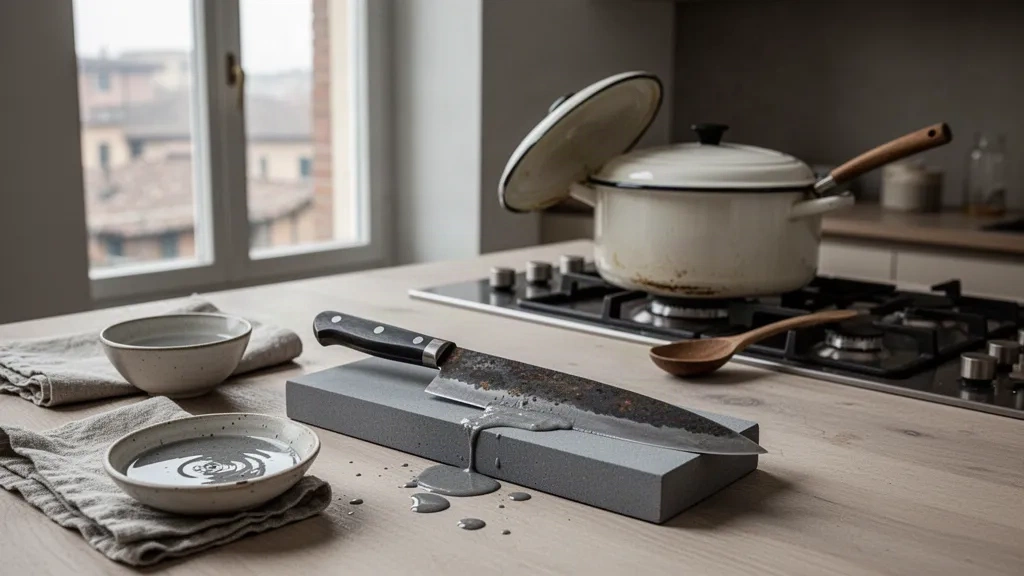
The knife I use for everything had gone dull without my admitting it, so after the washing up I got out the stone and did it properly. You cannot hurry a knife. Twenty minutes of small, even circles at one angle, and if you lose your temper and lean on it you grind a curve into the blade and spend another twenty minutes taking it back out. It’s the same lesson I keep meeting on the computer: when there’s a long job that doesn’t need to be finished this minute, I run it with nice — nice -n 19 tar -czf archivio.tgz cartella/ tells the machine to give that job whatever’s left over and let everything else go first. The work still gets done. It just stops shoving.
The pot is cooling on the stove, the clock is still wrong, and I’m going to bed early.
Recipe: Pasta e Ceci
Ingredients
- 250 g dried chickpeas, soaked overnight (or 2 tins, drained, with their liquid)
- 3 tablespoons olive oil
- 1 small onion, finely chopped
- 1 carrot and 1 celery stalk, finely chopped
- 1 sprig rosemary
- 1 tablespoon tomato paste (optional)
- about 1.2 litres water or light stock
- 200 g short pasta (ditalini, tubetti, or broken spaghetti)
- salt and black pepper
- good olive oil, to finish
Preparation
- Warm the oil in a heavy pot and cook the onion, carrot, and celery gently until soft, about 8 minutes. Stir in the tomato paste if using.
- Add the drained chickpeas, the rosemary, and enough water to cover by a few centimetres. Simmer until completely tender, 60–90 minutes for soaked dried chickpeas (15 minutes if using tinned).
- Fish out the rosemary. Take out a ladleful of chickpeas, mash them to a rough paste, and stir them back in — this is what thickens the pot.
- Add the pasta and cook it in the same pot until al dente, stirring now and then and adding hot water if it gets too thick. It should be spoonable, not soupy.
- Salt to taste, grind in pepper, and let it sit off the heat for 5 minutes. Serve with a drizzle of raw olive oil. Even better the next day, thinned with a little hot water.