
The Fountain in the Lower Square
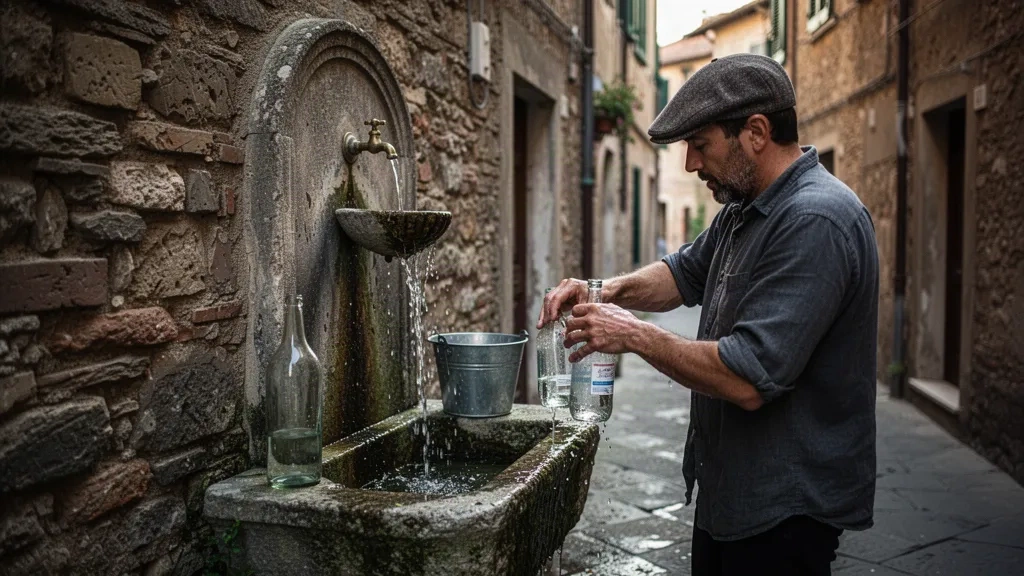
I went down into the older part of the village this morning, where the lanes narrow to arm’s width and the houses have no room for gardens, and for once I stopped at the fountain instead of walking past it. It’s been there longer than anyone remembers and it has no tap — the water simply runs, a thin steady stream into a stone basin that’s been hollowed at the spout into a shallow bowl by decades of hands and bottles and buckets. There’s a groove worn under the spout where the water always falls. I filled my bottle, sat on the lip, and watched a man in a flat cap rinse two glass bottles, fill them, nod at me, and go. Nobody thinks about that fountain until the day it stops, which is the way with most things that hold a place together.
Home, the morning had turned into bread, because the cupboard was down to the heel of last week’s loaf. Flour, water, salt, a little yeast, and time — that’s the whole list, and the time is the ingredient people skip. I mixed it, left it twenty minutes before kneading so the flour could drink, kneaded it only until it stopped fighting me, and then let it rise slowly in the cool room while I did other things. A slow rise is not laziness; it’s where the flavor comes from. I baked it in a hot oven and tore a piece while it was still too warm to hold, dipped it in oil, added salt. Bread and oil is not a sad meal. It’s the uncomplicated one, and some evenings that’s exactly what I want.
I used the old bread board for the shaping — the grey one, scored all over from knives and decades of cutting, thin in the middle. While the loaf cooled I was at the laptop fixing a path I’d mistyped for the fourth time, and instead of holding backspace like a woman with a grudge, I used the two shortcuts that save me constantly: Ctrl+W deletes the word behind the cursor, Ctrl+U clears the whole line. Start the line again in a second instead of picking at it letter by letter. Small thing. But I mistype a lot, so it’s a small thing I use every day.
The loaf is wrapped in a cloth on the board, the bottle is on the counter, and the fountain is still running down there in the dark. Nobody had to do anything for it today.
Recipe: Pane Casa (Everyday Bread)
Ingredients
- 500 g bread flour (tipo 0 or a strong white flour)
- 350 ml lukewarm water
- 10 g fine salt
- 5 g fresh yeast, or 1½ teaspoons dried
- a little olive oil for the bowl
Preparation
- Crumble the yeast into the water and stir to dissolve. Put the flour in a large bowl, add the water, and mix to a shaggy dough. Cover and leave 20 minutes.
- Add the salt and knead 8–10 minutes, until the dough is smooth and springs back when pressed. Oil the bowl, return the dough, cover, and let it rise slowly somewhere cool for 2–4 hours, until roughly doubled.
- Turn the dough onto a floured board, press it flat, fold it over on itself a few times, and shape it into a round or an oval. Let it rise again, covered, 45–60 minutes.
- Heat the oven to 230°C (450°F) with a heavy pot or a tray of water on the lower shelf for steam. Slash the top of the loaf with a sharp knife.
- Bake 35–40 minutes, until dark gold and hollow-sounding when tapped underneath. Cool on a rack before cutting — it’s still cooking inside. It’s best the day it’s made, and good toasted for two days after.